
Case Study 1: AI-Powered Sales Forecasting
Client Introduction:
A European manufacturer of household plastic products, active in the market for several decades, offering a wide range of items – from food containers and kitchen accessories to organizers, bins, and children’s products.
Client Challenge:
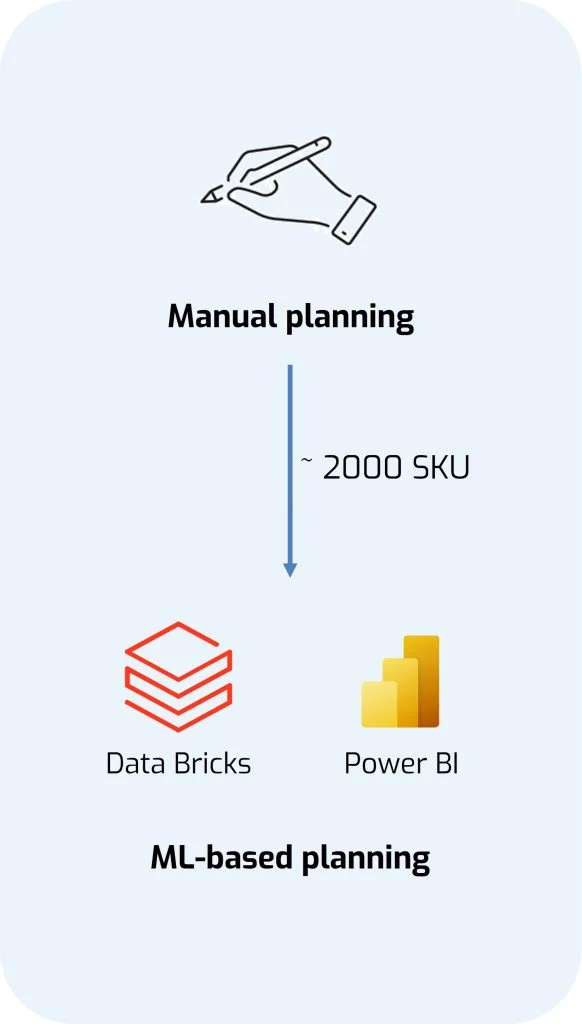
The company faced challenges with manually planning sales volumes and sought to improve forecast accuracy through demand sensing, enabling more responsive and data-driven inventory and production planning.
Implementation Results:
– Improved forecast accuracy and reduced bias
– Faster and more efficient planning
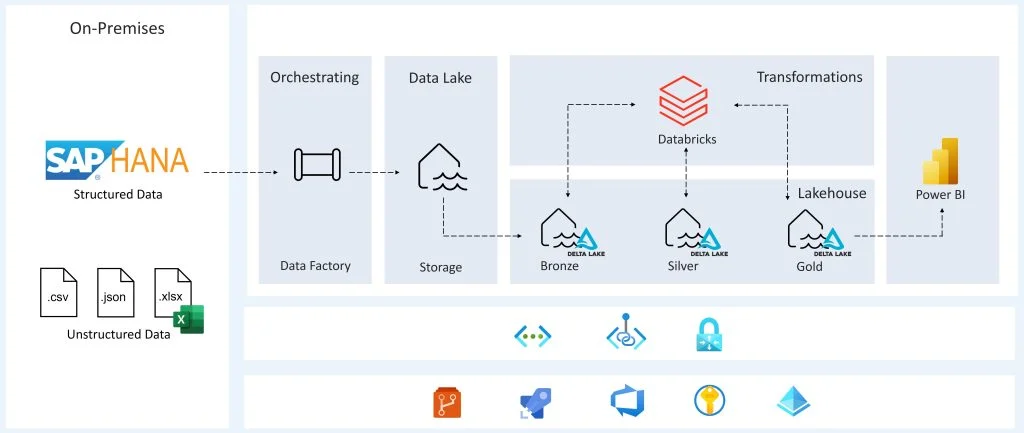
The solution was built on a modern Azure Lakehouse architecture, integrating on-premises SAP data (approx. 2,000 SKUs) and external data sources into a unified, scalable cloud environment. Data ingestion and orchestration are fully automated using Azure Data Factory, with structured storage in Azure Data Lake Storage following a layered Bronze / Silver / Gold Delta Lake approach. The Bronze layer captures raw ERP and external data, the Silver layer ensures data cleansing, transformation, and integration, and the Gold layer provides a curated analytics-ready dataset optimized for AI-driven sales forecasting and business intelligence.
Machine learning models are developed and deployed in Azure Databricks, generating short-term demand forecasting outputs for 1–5 weeks ahead at multiple aggregation levels (SKU, SKU by factory, and product groups). Forecast results are delivered through interactive Power BI dashboards, enabling data-driven sales planning, production planning, and inventory optimization.
This cloud-based data platform ensures high scalability, automated data pipelines, strong data governance, and modular extensibility. By combining Microsoft Azure, Databricks, Delta Lake, and Power BI, the architecture provides a robust foundation for advanced analytics, AI-powered demand sensing, and continuous improvement of forecast accuracy across the organization.
Case Study 2: Copilot Implementation
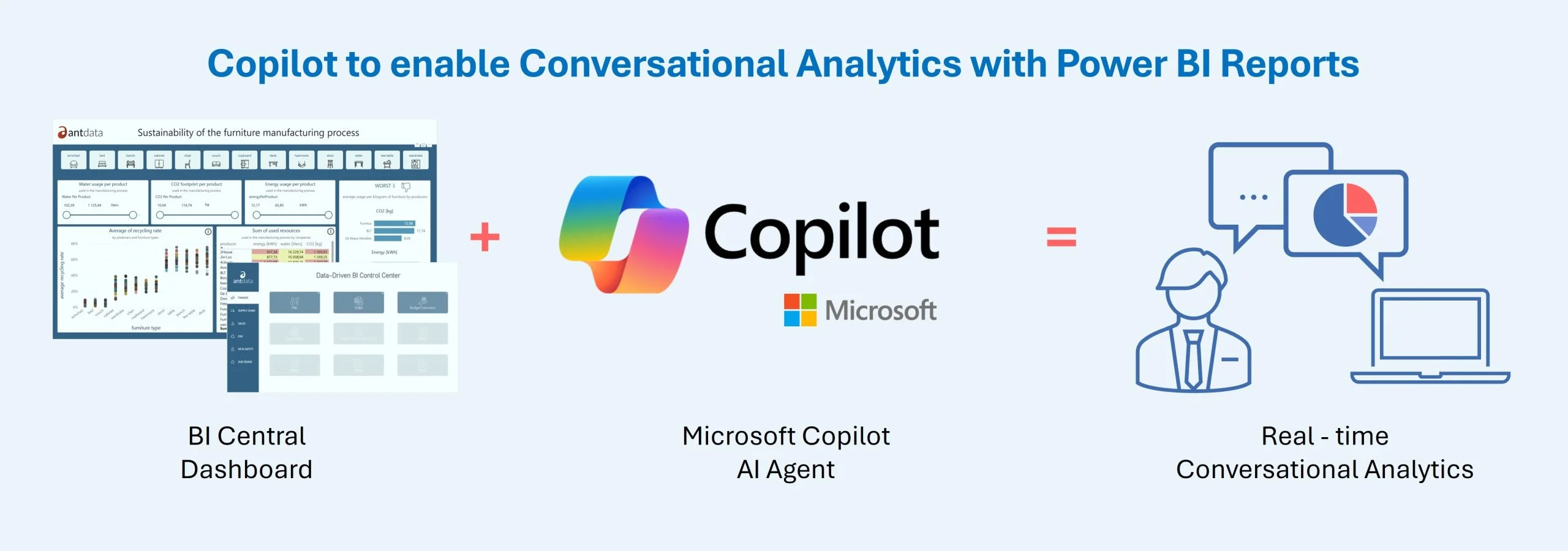
The integration of a Power BI – Data Model with an AI agent such as Microsoft Copilot within Power BI enables true real-time conversational analytics.
In this architecture, the AI Agent translates natural language questions into optimized DAX and SQL queries, interacting directly with the semantic data model. By automatically generating measures, calculations, and queries, it removes the need for manual coding while preserving analytical precision and performance.
The result is immediate access to KPIs, forecasting insights, and performance metrics through conversational interaction. This combination of LLM capabilities, automated DAX and SQL generation, and enterprise BI infrastructure delivers measurable analytical value – transforming traditional dashboards into intelligent, real-time decision support systems.
LLM – OEE Case Study
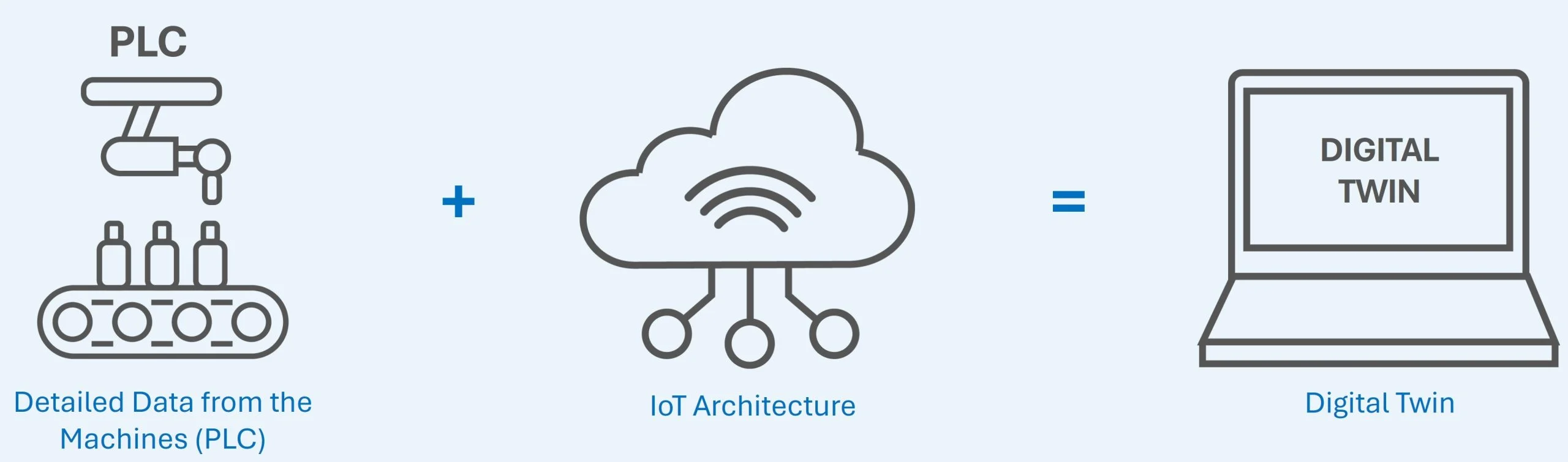
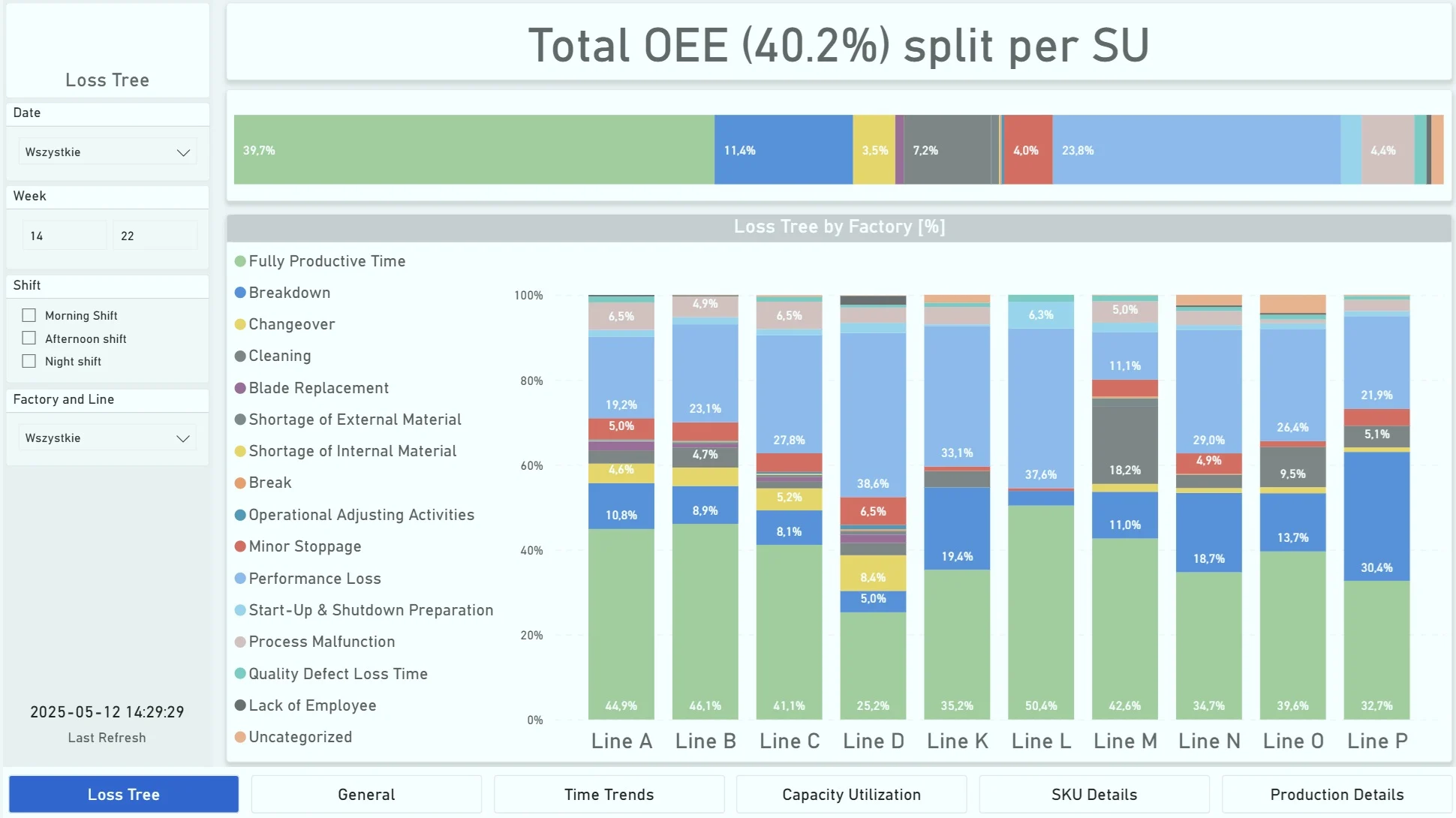
This case study is built around a clear technological foundation: PLC detailed machine data + IoT architecture = Digital Twin. By combining granular production signals from PLC controllers with a scalable IoT data pipeline, it becomes possible to create a dynamic digital twin of the manufacturing environment – reflecting real machine states, performance parameters, and process conditions in near real time.
At the analytical layer, Large Language Models taught on organization data enable contextual understanding of operational processes, maintenance procedures, and performance standards. When enriched with internal documentation, historical production data, and OEE benchmarks, LLMs move beyond generic language capabilities and become domain-aware operational assistants.
Integrated with Microsoft Copilot as an AI Agent, the system interprets machine-level KPIs such as OEE (Overall Equipment Effectiveness), availability, performance, and quality metrics. Combined with custom Machine Learning models for anomaly detection and predictive analytics, this architecture enables intelligent root cause analysis and automated recommendations.
A key outcome is CIP optimization (Clean-In-Place) – a critical industrial process used for automated cleaning of production equipment without disassembly. By correlating OEE indicators, machine cycle data, and cleaning matrices, the AI system can recommend optimal CIP timing, duration, and resource usage. This reduces downtime, improves production efficiency, and ensures compliance with operational standards.
The result is an AI-driven OEE framework where the Digital Twin, IoT architecture, Machine Learning, and LLM-powered AI Agents work together to deliver measurable operational optimization – bridging physical production systems with intelligent, data-driven decision support.
Get in touch with us
Book a consultation call and we will get back to you.
Select a date for a consultation phone call.